


If you are over 50 and regularly contribute to a retirement plan, you may already be aware that your contribution limit is higher than those under 50 thanks to a provision for “catch-up” contributions. This enables those in their highest-earning years to sock extra money away for retirement.
Starting this year, these relatively simple catch-up rules get more complicated for 401(k)s, 403(b)s, SIMPLE IRAs and other employer-run retirement plans.
Traditional IRAs, Rollover IRAs & Roth IRAs
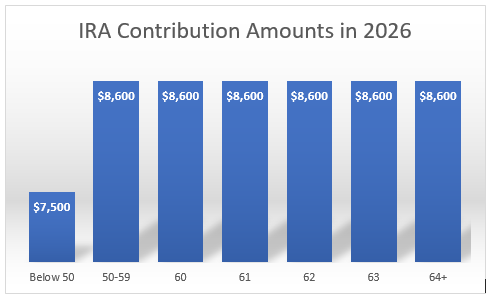
The rules for Traditional, Rollover, and Roth IRAs remain the same: those over 50 with income from employment (and who have income below the phase-out range if contributing to a Roth IRA) can continue to contribute an additional $1,100 per year over the standard IRA contribution limit. In 2026, that means that workers under 50 can contribute up to $7,500 per year and those 50 or older can contribute up to $8,600.
401(k)s, 403(b)s, 457s and Thrift Savings Plans
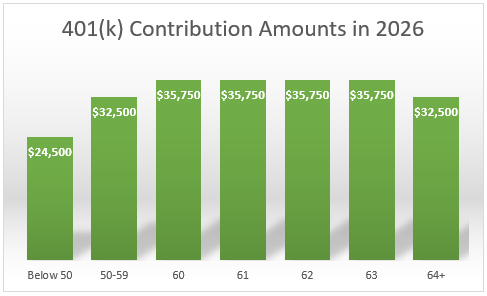
The new catch-up rules for these accounts now feature two age ranges for catch-up contributions. Workers 50 and older are entitled to contribute an extra $8,000 (2026) for a total contribution of $32,500 (2026). Workers age 60-63 gain an additional $3,250 (2026) on top of the age 50+ catch-up totaling $35,750 for 2026. Once you turn 64 your allowed contribution drops to the age 50+ allowed contribution.
SIMPLE IRAs & SEP IRAs
SEP IRAs do not allow employee deferral contributions in the same way 401(k)s do. However, you can make traditional IRA contributions to your account in the SEP IRA plan, meaning SEP IRA catch-up amounts remain the same as Traditional/Roth/Rollover catch-up amounts.
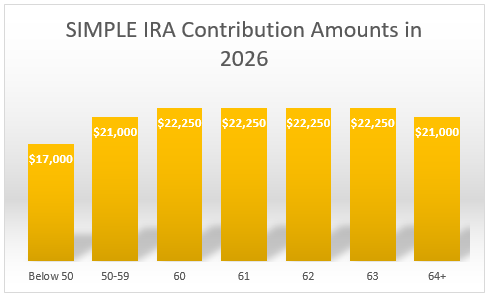
SIMPLE IRAs, however, do allow employee deferrals. In 2026, participants can contribute up to $17,000 and those 50+ can contribute an additional $4,000. Those in ages 60-63 can contribute an additional $5,250 on top of the base amount, making the below limits.
HSAs
Health Savings Accounts (HSAs) also allow catch-up contributions for those 55+ but do not provide an additional catch-up for those 60-63. In 2026, that allows an additional contribution of $1,000 per year over the base limit of $4,400 for individuals and $8,750 for families.
Catch-Up Contributions Treatment
The second part of these new catch-up contribution rules requires that participants in 401(k), 403(b), 457, and Thrift Savings Plans whose W-2 wages were $150,000 or more in the prior year (2026 numbers) must have their catch-up contributions directed to Roth accounts, provided the employer plan offers a Roth option. They cannot have their catch-up contributions directed to traditional 401(k)s, 403(b)s, 457s or TSPs regardless of where their normal contributions are directed.
If the plan does not offer a Roth option, the high-earning participant is not allowed to make any catch-up contributions. If your employer retirement plan does not offer a Roth option it may be wise to request they do.
Self-employed individuals may have different requirements around the catch-up contributions for high earners, depending on the plan type and business structure. Talk to your financial advisor or tax preparer to find out if you are subject to this requirement.
Payroll companies are already aware of the updated rules around the extra catch-up amounts and the Roth provision for high earners. However, you may need to update your deferral amounts once you turn 50 and once you turn 60 in order to take advantage of the higher limits.
If you have questions about your retirement amount contributions, call an advisor at American Money Management, LLC today.